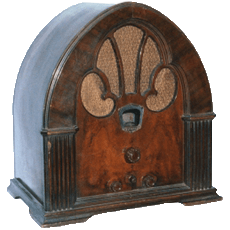
Philco 41-608 electrolytics
Posts: 3
Threads: 1
Joined: May 2019
City: Fort Pierce
State, Province, Country: Florida
Restoring a Philco 41-608. The filter cap installed in philco part #30-2488S. Markings are Red 16-400 / Green 8- 400, Black Com, Neg Blue 12-400 / Yellow Neg. Thats 5 leads coming out of the can. The schematic shows the 12 mfd (C21B) negative going to the 780 ohn, 268 ohm junction of R77. The negative of the 16 mfd (C21A) going to the 28 ohm and 26 ohm junction of R77. The 8 mfd (C21) negative goes to ground.By my count that is six (6) leads. The wiring in the radio hace the Black to ground, the Blue ((C21B) to the field and the 7Y4, the Green (C21) to the junction of R20 R26 and R36, the Yellow (C21A) to the junction of R77 780 ohm and 268 ohm. Is my schematic wrong?
(This post was last modified: 05-20-2019, 09:03 PM by islesailor.)
Posts: 7,323
Threads: 270
Joined: Dec 2009
City: Roslyn Pa
Using the diagram fo the library it looks correct. There are three separate caps but there is no "common" because none of the minuses are connected together. This is why there are six wires.
When my pals were reading comic books
I was down in the basement in my dad's
workshop. Perusing his Sam's Photofoacts
Vol 1-50 admiring the old set and trying to
figure out what all those squiggly meant.
Circa 1966
Now I think I've got it!
Terry
Posts: 3
Threads: 1
Joined: May 2019
City: Fort Pierce
State, Province, Country: Florida
The problem is the current can in the radio does NOT have six wires, only 5. I have cleaned out the can and rebuilding the electrolytic package and wondered if I shouold wire it according to the schematic or the wat it is dcurrently wired in the radio.
Posts: 7,323
Threads: 270
Joined: Dec 2009
City: Roslyn Pa
I would follow the diagram. Do go w/450v caps. A couple of 22 and a 10mfd will be fine.
GL
When my pals were reading comic books
I was down in the basement in my dad's
workshop. Perusing his Sam's Photofoacts
Vol 1-50 admiring the old set and trying to
figure out what all those squiggly meant.
Circa 1966
Now I think I've got it!
Terry
Posts: 5,584
Threads: 291
Joined: Nov 2012
City: Wilsonville
State, Province, Country: OR
The 8uF portion of the #21 can has its negative lead to ground so they probably internally connected that electrolytic to the can and used the can mounting to the chassis to make the ground connection. Thus you only need 5 wires for the remaining connections.
Posts: 2
Threads: 0
Joined: Sep 2020
City: Cleveland
State, Province, Country: Ohio, USA
On any other forum this would be considered a zombie thread, but since we're dealing with 80-year-old radios, no thread ever dies 
I ran into the same issue as islesailor, so I carefully dissected the 30-2488S cap to determine what was really inside. The description on the can is correct: there are three sections, but two of them (Red - 16uF and Green - 8uF) share a common negative lead (Black), and the third section (Blue - 12uF, Yellow - Neg.) is isolated, hence the 5 wires. There's no internal connection to the can.
Now for the schematic. I believe the wiring for the cap is incorrect as shown, for three reasons:
1. Since the black negative lead is common to the 16uF and 8uF, it can't possibly go to the two separate points shown.
2. The schematic doesn't match the way the 41-608 was wired at the factory.
3. The cap wiring doesn't match the power supply design of other, very similar sets, e.g., the 41-280, 41-250 and 41-610.
Unfortunately, the schematic error seems to be an old-timey literal copy/paste that got propagated through several models.
The factory wiring of the cap in the 41-608 does match the 41-280 design, and it makes sense. The negative side (black lead) of the 16uF and 8uF actually goes to chassis ground, which is typical of the design of many radios. I'd highly recommend wiring this way when re-capping, because wiring according to the 41-608 schematic could introduce noise on the output. I'll try to confirm this when I'm at that point in the restoration process.
Cheers!
-Brian
Posts: 7,323
Threads: 270
Joined: Dec 2009
City: Roslyn Pa
There is a reason why 21,21A, and 21B are wired as per the schematic.
21A and B filter the both the B- and B+ outputs of the power supply. If those are connected to the chassis and the bias resistor it will short out any negative voltages used to grid bias the 1st audio stage and the output stage. Means excessive plate current and distortion.If you just connect them to the chassis w/o connecting them to the bias resistor then they won't filter out the 60cy hum in the - side of the power supply. Means hum. 21 is used for decoupling any audio signals that maybe modulating the B+. It's only connected across the + side of the hv.
When my pals were reading comic books
I was down in the basement in my dad's
workshop. Perusing his Sam's Photofoacts
Vol 1-50 admiring the old set and trying to
figure out what all those squiggly meant.
Circa 1966
Now I think I've got it!
Terry
Posts: 2
Threads: 0
Joined: Sep 2020
City: Cleveland
State, Province, Country: Ohio, USA
Good afternoon, Terry.
tl:dr: The only change I'm recommending is as marked in the image here: 41-608 correction. This makes the schematic match the as-built reality of a factory production 41-608 unit.
The long version:
If you re-read the original post, I didn't suggest that -all- the negative connections for 21, 21A and 21B should go to the chassis. 21B is correct as shown but, exactly for the reasons you cited, the negative connection for 21/21A should (and does, as built by Philco) go to another point -- in this case, the chassis.
I'll try to restate and clarify:
1) 21, 21A and 21B are all potted in the same can, marked 30-2488S on the side, also marked 30-2488 on top of the can. Upon dissection, 21B is completely isolated, having its own negative lead (the yellow wire). 21 and 21A have a single, -common- negative lead (the black wire) coming out of the can. This agrees with the printing on the side of the can, and this is why there are only 5 wires exiting the can, not 6. There is no internal electrical connection between the can and any of the caps.
2) As manufactured, it's impossible for 21 and 21A to be wired according to the schematic. They have a single, common negative connection (the black wire as stated in #1 above), but they are shown connected to two, electrically separate points (chassis for 21, jct. of the 26 ohm/28 ohm on 77 for 21A) on the schematic. In reality, factory wiring has their common negative connection (black wire) to the chassis, which is exactly how the 41-250, for example, is wired.
3) Opinion: Even if it was possible with the original part, I don't think there's a good reason to bias the negative side of 21A below chassis ground, and it may even be detrimental to the operation.
See what I'm saying?
Cheers!
-Brian
Users browsing this thread: 4 Guest(s)
|
|
Recent Posts
|
|
Philco P45-6365 Universal Transformer Instruction Manual
|
| Can anyone guide me to where this may be found?GRG — 03:00 PM |
|
54C Complete Teardown/Rebuild
|
| I don't think that I have encountered a 12Z3 before, curious how it uses one of those but includes a #43, which is a 25 ...Arran — 02:17 PM |
|
HiFi (Chifi) tube amp build - but my own design.
|
| It's the other forum. I'm also in DIY, but mostly read there. Honestly, I kinda jumped into this without much thought to...TV MAN — 10:43 AM |
|
Philco 71 Code 125
|
| Hello,
I am in need of a schematic for this radio. Mine has the three separate circular tube shields and a shadow me...dconant — 08:06 AM |
|
Stromberg Carlson 1500 Squeal
|
| And life just keeps getting more complicated.dconant — 07:57 AM |
|
54C Complete Teardown/Rebuild
|
| Hello Roy,
here is this one
sincerely Richardradiorich — 12:45 AM |
|
54C Complete Teardown/Rebuild
|
| Richard,
Had grabbed it already but thank you just the same. I find myself wanting to find some way to block out the...glyphmon — 12:03 AM |
|
54C Complete Teardown/Rebuild
|
| Hello roy,
here is a link to the schematic .
Sincerely Richardradiorich — 11:54 PM |
|
54C Complete Teardown/Rebuild
|
| Richard,
The Silvertone 2014 also is a transformerless set, so I am incorporating a 1:1 600 ohm audio isolation transfo...glyphmon — 11:37 PM |
|
Preliminary work on wife's Silvertone 2014
|
| Did an alignment today which was interesting. IF alignment went great, almost all was already spot-on. Adjusting on th...glyphmon — 11:35 PM |
|
Who's Online
|
There are currently 2647 online users. [Complete List]
» 1 Member(s) | 2646 Guest(s)
|
|
|

|
 
|