


08-26-2025, 07:16 AM
Hi Antipodal,
Yes, the sound will be quite big. If your set does not have a "Radio - Phono" or "Aux In" jack and switch, consider installing one. I am a big fan of installing an "aux input" or Radio - Phono Switch for 2 reasons. First off, it is a good "divide and conquer" troubleshooting technique for no sound, poor sound or distorted sound. Secondly, one can better enjoy the radio by connecting to MP3, computer, etc. that has "period" music or "Old Time" radio broadcasts such as radio plays, variety shows, playback of historical news broadcasts (WWII correspondents, etc.), when played directly through the audio circuit than using a home AM transmitter. Forget decent music over AM, at least here in the US. In fact, many US auto manufacturers are considering dropping AM totally from car radios.
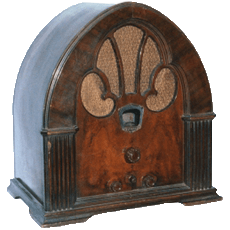
The most unique feature of this set is the Class B Push Pull circuit using 6AC5 triodes with the drivers direct coupled to the output tubes. However, returning this set to normal operation will not be much different other sets. Replace all electrolytic and paper - foil caps and check tubes to start, then take it for a test run.
Don't anticipate total HiFi, especially if playing classical music (IMHO, the hardest thing to reproduce), but big band music should be fine. Class B gives rather high power but has a higher distortion level than Class A or Class AB1 Push Pull amps. But during this time, a THD (Total Harmonic Distortion) of less than 5% was considered "distortion free" as opposed to real HiFi amps whose THD was often less than 1% or even 0.05%.
My friend would hook up his Ibanez "Stratocaster" copy guitar to his Crosley 02AC radio, which employs a very similar audio circuit to yours, and play jazz guitar. Sounded kind of nice. Not a Marshall "stack" to be sure but if looking for soft, clean guitar sound, this was pretty good.
A presentation of this set to your radio club will be quite interesting. Class B output stages became somewhat popular in the early 1930s due to the high power output efficiency and high output with low expense, however, at the expense of distortion. Some early 1930s sets had an output of as much as 20 watts. This is before the advent of Beam Power pentodes such as the 6L6, and 6V6, revolutionary tubes for high power with good fidelity, which popularized Class AB1 and AB2 circuits for high power. Class B was popular in farm radios and car radios where high output was desired but due consideration had to be paid to how much current the set needed or where cost of replacing B Batteries was a major concern. A "Class B" circuit has rather low plate dissipation with low sound or no sound output as opposed to Class A where the plate dissipation is high even with no signal output.
I have 2 RCA "Farm" sets, a 5 BT and 6BT, powered by 2V "A" Battery and three 45V B Batteries for a total of 135V. These sets have an output of 2 Watts, as opposed to many other farm sets of this vintage with single ended triodes or pentodes having an output of 500 milliwatts or less. The 5BT used the type 19 Dual Triode, specifically designed for Class B operation.
The following excerpts are from the 1940 (RC14) edition of the RCA Receiving Tube Manual. The first explains the 6AC5 tube, a high mu triode specifically designed for Class B operation and with the driver stage direct coupled to it:
The second is from the "Applications" section of the same manual, which discusses Class A, B, AB and C amplification:
There is a lot of good info in this attachment, discussing the different classes of amplification with their attributes and liabilities. Feel free to share this info and this post with your club.
Hope this helps.
Yes, the sound will be quite big. If your set does not have a "Radio - Phono" or "Aux In" jack and switch, consider installing one. I am a big fan of installing an "aux input" or Radio - Phono Switch for 2 reasons. First off, it is a good "divide and conquer" troubleshooting technique for no sound, poor sound or distorted sound. Secondly, one can better enjoy the radio by connecting to MP3, computer, etc. that has "period" music or "Old Time" radio broadcasts such as radio plays, variety shows, playback of historical news broadcasts (WWII correspondents, etc.), when played directly through the audio circuit than using a home AM transmitter. Forget decent music over AM, at least here in the US. In fact, many US auto manufacturers are considering dropping AM totally from car radios.
The most unique feature of this set is the Class B Push Pull circuit using 6AC5 triodes with the drivers direct coupled to the output tubes. However, returning this set to normal operation will not be much different other sets. Replace all electrolytic and paper - foil caps and check tubes to start, then take it for a test run.
Don't anticipate total HiFi, especially if playing classical music (IMHO, the hardest thing to reproduce), but big band music should be fine. Class B gives rather high power but has a higher distortion level than Class A or Class AB1 Push Pull amps. But during this time, a THD (Total Harmonic Distortion) of less than 5% was considered "distortion free" as opposed to real HiFi amps whose THD was often less than 1% or even 0.05%.
My friend would hook up his Ibanez "Stratocaster" copy guitar to his Crosley 02AC radio, which employs a very similar audio circuit to yours, and play jazz guitar. Sounded kind of nice. Not a Marshall "stack" to be sure but if looking for soft, clean guitar sound, this was pretty good.
A presentation of this set to your radio club will be quite interesting. Class B output stages became somewhat popular in the early 1930s due to the high power output efficiency and high output with low expense, however, at the expense of distortion. Some early 1930s sets had an output of as much as 20 watts. This is before the advent of Beam Power pentodes such as the 6L6, and 6V6, revolutionary tubes for high power with good fidelity, which popularized Class AB1 and AB2 circuits for high power. Class B was popular in farm radios and car radios where high output was desired but due consideration had to be paid to how much current the set needed or where cost of replacing B Batteries was a major concern. A "Class B" circuit has rather low plate dissipation with low sound or no sound output as opposed to Class A where the plate dissipation is high even with no signal output.
I have 2 RCA "Farm" sets, a 5 BT and 6BT, powered by 2V "A" Battery and three 45V B Batteries for a total of 135V. These sets have an output of 2 Watts, as opposed to many other farm sets of this vintage with single ended triodes or pentodes having an output of 500 milliwatts or less. The 5BT used the type 19 Dual Triode, specifically designed for Class B operation.
The following excerpts are from the 1940 (RC14) edition of the RCA Receiving Tube Manual. The first explains the 6AC5 tube, a high mu triode specifically designed for Class B operation and with the driver stage direct coupled to it:

The second is from the "Applications" section of the same manual, which discusses Class A, B, AB and C amplification:
There is a lot of good info in this attachment, discussing the different classes of amplification with their attributes and liabilities. Feel free to share this info and this post with your club.
Hope this helps.
"Do Justly, love Mercy and walk humbly with your God"- Micah 6:8
"Let us begin to do good"- St. Francis
Best Regards,
MrFixr55


