



01-22-2026, 07:10 AM
Edited 01/22/2026 with corrections and additions.
Welcome to the Phorum, SlidesK. We are very happy to have you here and are always happy to help!
Please reread this post as I have updated it several times while you were also online.
Check your wiring, as well as the sockets. It may be useful to print the schematic and "white out" the solid wiring, the 35Z5 heater that reflects wiring used for the 35Z5 if you have a 35Z3. Pencil in the 35Z3 heater in place of the 35Z5 heater. One end of the 35Z3 heater and the plate connect to the power line. The other heater terminal connects to the 50L6.
For clarity (or at least as clear as I can draw), attached below is a copy of the schematic as modified for the Code 122 chassis. Unfortunately, many companies do not put tube pin numbers on the schematic. Philco is one of these.
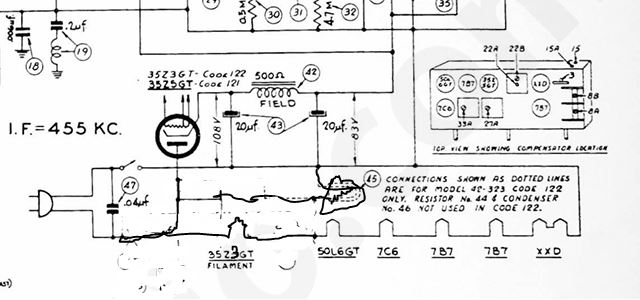
You can "ohm" across the sockets with tubes in place to check continuity between the socket pins and the tube heaters (filaments). Heater pins for the XXD, 7B7, 7C6 and almost all "loctal" tubes are pins 1 and 8. The heater pins for a 50L6 and 35W4 are 2 and 7. Once you verified that "socket" readings for heater resistance match the direct to pin readings, ohm the "heater" string from end to end, from the XXD to the 35Z3. Making these measurements should isolate the reason for no heaters.
The XXD is the Philco part number for a 14AF7. Check across the power cord with a VOM. If it lights the dimbulb, it could be a dead short. Either way, if it lights the dimbulb but the tube filaments don't light, you may be dealing with a miswiring issue.
Also, definitely check cap (capacitor) #47, across the power line and cap s #18 and#19 which connect the chassis to B-. Cap 47 likely shorts at power line voltages. Just remove it for now. Its purpose is to filter line noise. Replace Cap #47 with a Type Y "Safety Cap". Caps 18 and 19 can leak, making the chassis "hot" Don't worry about the coil around cap 19. You can try to duplicate it with wire or just eliminate it. The radio will work without the coil of wire which acts as a choke.
I dont, for the life of me know why radio manufacturers insisted in putting the switch in the "return" side (B-, "low end" of the heater string". This makes the chassis warm depending of the polarity that the plug is inserted into the outlet and whether the power switch is on or off. I install polarized power plugs on all my AC-DC sets and move the switch to the "hot" side. This makes the radio safer, but that can wait till I write a definitive article on the subject and you get the radio to work. Maybe I will do this when we get snowed in Sunday / Monday. (Not official yet but my neck o' the woods, Long Island, NY is supposed to get 12" or more of snow, then the temp is supposed to drop to 18Degrees. Oh well, 37 days till March.)
Unfortunately, most sets made in the late 1930s to early 1940s used rubber wiring which was a disaster. Newer sets used modern thermoplastics.
Good luck and keep us posted. I'm sure that you will solve this problem!
Welcome to the Phorum, SlidesK. We are very happy to have you here and are always happy to help!
Please reread this post as I have updated it several times while you were also online.
Check your wiring, as well as the sockets. It may be useful to print the schematic and "white out" the solid wiring, the 35Z5 heater that reflects wiring used for the 35Z5 if you have a 35Z3. Pencil in the 35Z3 heater in place of the 35Z5 heater. One end of the 35Z3 heater and the plate connect to the power line. The other heater terminal connects to the 50L6.
For clarity (or at least as clear as I can draw), attached below is a copy of the schematic as modified for the Code 122 chassis. Unfortunately, many companies do not put tube pin numbers on the schematic. Philco is one of these.
You can "ohm" across the sockets with tubes in place to check continuity between the socket pins and the tube heaters (filaments). Heater pins for the XXD, 7B7, 7C6 and almost all "loctal" tubes are pins 1 and 8. The heater pins for a 50L6 and 35W4 are 2 and 7. Once you verified that "socket" readings for heater resistance match the direct to pin readings, ohm the "heater" string from end to end, from the XXD to the 35Z3. Making these measurements should isolate the reason for no heaters.
The XXD is the Philco part number for a 14AF7. Check across the power cord with a VOM. If it lights the dimbulb, it could be a dead short. Either way, if it lights the dimbulb but the tube filaments don't light, you may be dealing with a miswiring issue.
Also, definitely check cap (capacitor) #47, across the power line and cap s #18 and#19 which connect the chassis to B-. Cap 47 likely shorts at power line voltages. Just remove it for now. Its purpose is to filter line noise. Replace Cap #47 with a Type Y "Safety Cap". Caps 18 and 19 can leak, making the chassis "hot" Don't worry about the coil around cap 19. You can try to duplicate it with wire or just eliminate it. The radio will work without the coil of wire which acts as a choke.
I dont, for the life of me know why radio manufacturers insisted in putting the switch in the "return" side (B-, "low end" of the heater string". This makes the chassis warm depending of the polarity that the plug is inserted into the outlet and whether the power switch is on or off. I install polarized power plugs on all my AC-DC sets and move the switch to the "hot" side. This makes the radio safer, but that can wait till I write a definitive article on the subject and you get the radio to work. Maybe I will do this when we get snowed in Sunday / Monday. (Not official yet but my neck o' the woods, Long Island, NY is supposed to get 12" or more of snow, then the temp is supposed to drop to 18Degrees. Oh well, 37 days till March.)
Unfortunately, most sets made in the late 1930s to early 1940s used rubber wiring which was a disaster. Newer sets used modern thermoplastics.
Good luck and keep us posted. I'm sure that you will solve this problem!
"Do Justly, love Mercy and walk humbly with your God"- Micah 6:8
"Let us begin to do good"- St. Francis
Best Regards,
MrFixr55


